

India’s T20 Blueprint is Leaking: New Zealand Expose the Flaws


Published 2026-11-14 · By Karan Chatterjee (Executive Sports Editor · New Delhi Desk)

The wicket was a typical January slab—hard, lifeless, and utterly devoid of any help for the seamers. Then came the first over. Two wickets. Three balls. The New Zealand opening bowler wasn't doing anything magical; he was simply hitting a skiddy hard length that the Indian top order seemed biologically incapable of handling. It wasn't a collapse so much as a surrender.
Watching from the press box, the silence was deafening. We've seen this movie before. The aggressive intent promised in the pre-match presser vanished the moment the first ball beat the outside edge. It’s the same old story: a flurry of boundaries followed by a middle-overs choke that leaves the tail to do the heavy lifting.
The Myth of the 'Aggressive' Start
India’s current T20 philosophy is a contradiction. They want the 2024 World Cup fireworks but possess the risk-aversion of a Test match opener on a sticky red-soil track. The boundary-percentage in the first six overs was abysmal. When you play against a side as disciplined as New Zealand, you cannot afford to treat the powerplay like a gentle warm-up. You either take the game to them or you let them strangle you.
The dressing-room chatter—if the body language is any indication—is one of confusion. Is the goal to maximize the powerplay or to ensure we have wickets in hand for the death? You cannot do both with this particular batting lineup. The result was a stuttering start that put immense pressure on the middle order, who looked like they were playing a Ranji grind rather than a T20 international.
A Tactical Void at the Death
Bowling at the death has become a lottery for this side. The Impact Player gamble didn't pay off. Instead of a specialist who could nail the yorker, we saw a series of full tosses and wide long-hops that the Kiwis treated like a beach cricket festival. The dew factor after 8:30 PM IST played its part, sure, but dew doesn't make a bowler forget where the stumps are.
While fans are distracted by the latest trends—spending their downtime on a jaiho arcade apk download or arguing on X—the actual technical decay in our death bowling is alarming. We are relying on raw pace when we need subtle variations. The lack of a dependable slower-ball bouncer is a glaring hole in the strategy.
The Selection Headache
Who actually fits into this puzzle? The current squad feels like a collection of individuals rather than a cohesive unit. We have players who can blast 30 off 10 balls, and players who can anchor for 40 balls to score 25. There is no middle ground. The transition period has dragged on for too long.
Consider the stats from the 4th T20I:
| Phase | Run Rate (IND) | Run Rate (NZL) |
|---|---|---|
| Powerplay | 4.2 | 6.8 |
| Middle Overs | 5.1 | 7.4 |
| Death (Last 5) | 8.9 | 9.2 |
"We played to not lose, rather than playing to win. That is the fundamental flaw in our current approach to the shorter format."
The New Zealanders didn't outplay India; they simply out-thought them. They identified the hesitation in the Indian camp and exploited it with surgical precision. If the management continues to ignore the need for a specialist finisher who doesn't panic under pressure, the results will remain the same.
The series might be a wash, but the lessons are stark. Either we evolve our approach to the skiddy length, or we continue to be the team that looks great on paper but crumbles under the slightest bit of tactical pressure. The fans deserve more than just 'intent.' They deserve results.
Related coverage
- Hamilton’s Dew Dilemma Ends NZ Streak – Jaiho Arcade Apk Download Insight
- GPay’s Circle & Vouchers Upend UPI, But Where Is Jaiho Arcade Apk Download?

Updated 2026-11-14 · Instant Rupee Deposits & 60s Withdrawals · 24/7 Support.
Access Official LaptopBurka Portal →National Series Correspondent · Pune Desk
Nisha Agarwal reports on franchise leagues, the WPL, and domestic Indian tournaments for LaptopBurka. Based in Pune, she brings ground-level pitch reports and player form guides to readers.
Reader Discussion & Match Reactions (6)4.7★ Community (6 Comments)
Verified Indian cricket reader perspectives & tactical debate on laptopburka.com
Two wickets in three balls inside the first over, and that abysmal powerplay boundary percentage—those two numbers are the whole post-mortem. On a flat slab, losing 2 for 0 after three balls adds close to a run an over immediately. Telemetry never flatters anyone.
Here's the counterpoint the desk dodges: New Zealand's opening bowler needed nothing but hard-length discipline—no pitch favours, no fireworks. The real risk sits with selectors demanding the 2024 World Cup template from a lineup batting like sticky red-soil Test openers. Confused philosophy upstairs guarantees confused batting downstairs.
Why is 'playing a Ranji grind' the slur here? Red-ball battles are exactly where batters learn to blunt skiddy hard lengths, and state associations keep producing such scrappers in Ranji and SMAT while selection recycles the same top order. The middle order needs more grind, not less.
The powerplay-versus-death fork the writer flags is unsolvable with this batting unit—modelling both goals means the middle-overs choke hands run-a-ball liability to the tail. Until management picks one philosophy, every lifeless slab repeats this graph.
Plain talk: the curators served a hard, lifeless slab with nothing for the seamers, and a New Zealand opening bowler still took two wickets in three balls—skill beat conditions. Pre-match pressers promised intent; we got a gentle warm-up. Team management owns that dressing-room confusion, not just the batters.
@Saurabh_NRR Your asking-rate math tracks, but here's the human ledger: the article calls it surrender, not collapse. Body language turned confused the moment the first ball beat the outside edge, and once presser-briefed intent died, the dots compounded exactly as you described. Keepers notice these things first.
Join the Discussion (6 Reader Comments)
Related Articles
See All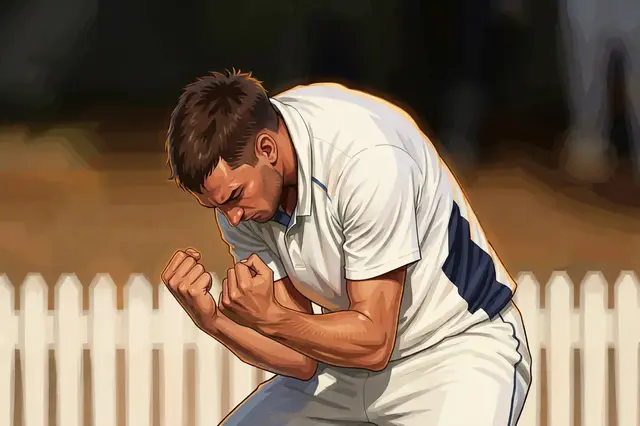
Jaiho Arcade Apk Download: Complete 2026 India Guide, Live Updates & Verified Access
Oct 17, 2026
Pakistan fielding coach Shane McDermott quits
Jul 12, 2026